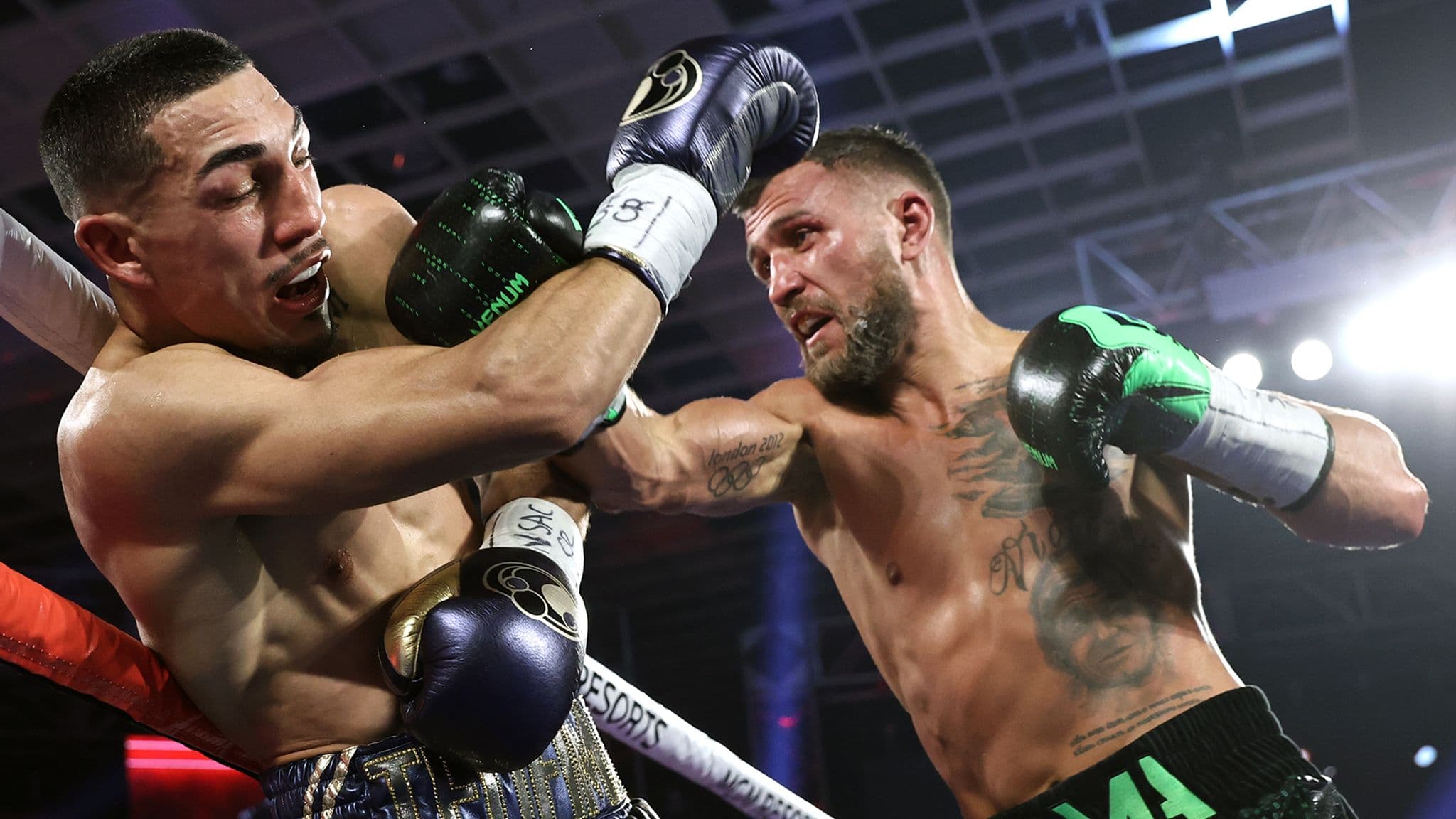
Some defeats are easy to explain. A boxer is too old, too small, too worn down, or simply ran into the better man. Then there are the more troubling fights, the ones that leave a strange gap between the official result and what actually unfolded, but also between the fighter people expected and the one who truly showed up in the ring. Vasiliy Lomachenko's loss to Teofimo Lopez in October 2020 belongs in that category.
On paper, the verdict is clear. Lopez won by unanimous decision, with scores of 119-109, 117-111 and 116-112. Officially, it was the biggest victory of his career, the night he added Lomachenko's belts to his own and became the unified lightweight champion. But those wide cards never really settled the debate. If anything, they deepened it, because the fight left the odd feeling that it had first been lost by Lomachenko before it had been fully won by Lopez.
The context matters. Lomachenko entered the fight as one of the best boxers in the world, firmly installed among the pound-for-pound elite, already holding three belts and still chasing total control of the division. Across from him, Lopez was rising fast. His knockout of Richard Commey had changed his profile overnight, and his physical package posed a real question. Bigger, stronger, more explosive, he was an obvious danger. Even so, very few observers imagined Lomachenko would spend half the fight looking like a man unwilling to step into his own moment.
That is what stood out most that night. For six rounds, maybe seven depending on the scorecard, Lomachenko boxed against his own nature. The fighter of angles, feints, smooth combinations and initiative became a cautious, mobile, almost passive figure. Lopez came forward, took the center of the ring, imposed the image of the aggressor and, in doing so, banked rounds visually. It was intelligent, serious, disciplined work. But it still did not look like total tactical domination. The lasting impression was not of a Lomachenko outclassed by a superior ring genius. It was of a Lomachenko absent from himself.
That is why the most interesting explanation is not merely physical. Yes, Lopez was an athletic beast. Yes, his hand speed, explosiveness and counter left hook were enough to make any lightweight hesitate. Yes, Lomachenko's shoulder may have mattered too, since he underwent surgery after the fight. But none of those explanations, taken on their own, really tells us why such an accomplished technician waited so long before actually starting his fight.
The mental angle deserves to be taken seriously. For months, Teofimo Lopez and especially his father had conducted a relentless verbal campaign. And this was not just generic trash talk. Lopez Sr. said it plainly: "I have to get inside Lomachenko's head." He also declared, "It's not going to even last three rounds," and then added, "There's no way a 126-pounder is going to beat my son. It's just impossible." For his part, Teofimo Lopez Jr. said he was going to "finish Lomachenko" and described a champion already in decline: "He's already on his way out, and it's showing." Taken one by one, those statements belong to boxing's familiar theater. Taken together, through repetition, they can become something else entirely: constant noise, psychological pressure, a way of imposing a climate before the fight even begins.
Lomachenko is not a fighter who seems to thrive on anger or on the urge to punish. On the contrary, his art depends on lucidity, calm, and instant reading of trajectories and reactions. His boxing becomes less special the moment his mind clouds over, the moment doubt slows the chain between perception, decision and execution. That is what makes this fight so fascinating on rewatch: he does not merely look cautious, he looks internally restrained. As if he wanted to do too much too perfectly, or as if he spent too long trying to avoid the kind of punishment that could change the fight in a single second.
That restraint was probably reinforced by the reality of the ring. Very early on, Lomachenko must have felt that he would not be able to establish his usual control without major risk. Lopez was solid on his feet, ready to fire counters, dangerous even when he was not landing clean. From there, the mental mechanism may have closed in on him: the Lopez camp had planted the idea of danger before the fight, and Teofimo's size and force confirmed it in the opening exchanges. An ordinary fighter can sometimes compensate for that. Lomachenko, whose entire style depends on fluidity, can be thrown off for several rounds by a few seconds of hesitation.
That is also why the second half of the fight matters so much. When Lomachenko finally decides to accelerate, the whole fight changes. His entries become cleaner, the variety returns, and there are stretches where Lopez is pushed back, forced to react, and looks far less comfortable. The rhythm is no longer the same, nor is the reading of the contest. Suddenly the Ukrainian champion looks like himself again, and the fight stops feeling like a controlled march toward a Lopez victory.
That is where the official cards become hard to accept. Giving the win to Lopez is perfectly defensible. He collected many of the early rounds, and he deserves credit for taking initiative where Lomachenko refused to engage. But the 119-109 card feels excessive because it almost erases Lomachenko's revival. The point is not to deny Lopez, much less to take away his performance. It is to reject an overly simple reading, the one in which he supposedly outsmarted and outboxed Lomachenko from the first round to the last.
The rest of their careers only reinforces that feeling. Lopez proved that he was a major talent, capable of beating anyone on a given night, but he never looked like an untouchable force. His loss to George Kambosos Jr. was a reminder that he remained vulnerable, beatable, human. Lomachenko, meanwhile, showed after that defeat that he was not suddenly finished. All of that encourages a different reading of their 2020 clash: less as an irreversible passing of the torch than as a night when the best version of Lomachenko showed up only halfway.
In the end, that may be the real sporting tragedy of the fight. Lomachenko did not simply lose to a younger, stronger and gifted opponent. He may have lost to the mental fog the Lopezes managed to build around him, and that the opening rounds then made real. The shoulder mattered. Lopez's physicality mattered too. But the most troubling key lies elsewhere: that night, Loma did not just box cautiously. He may have boxed with a cluttered mind, and for a stylist of that level, that was already a way of drifting to the dark side.